No more mister dice guy
Don’t get too comfortable.
It’s a crunchy, dicey machine of vibrant world-building that sometimes forgets itself in wandering prose.
But it has a good time trying.
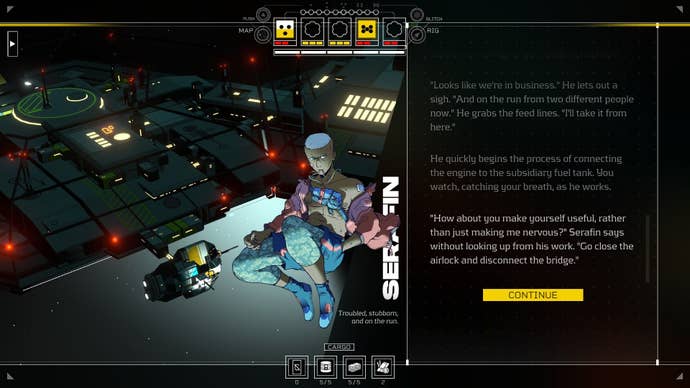
Once again you play a “Sleeper”, a biomechanical being designed to work as slave labour.
But it can also feel less deep and more formulaic with each passing hub-hop, too.
Perhaps this is down to the expansion of the game’s more cog-like components.

You slot these into various squares to take an action.
Slot a one into a “safe” activity, like resting.
The twos and threes?
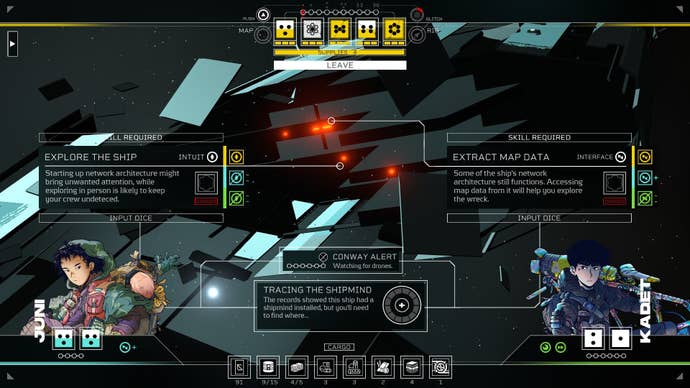
Well, those are iffy.
But gamble away, work another shift.
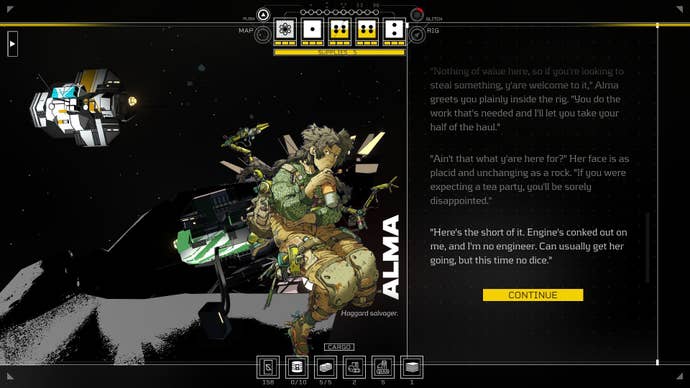
On contract missions you’ll also be able to use extra chance cubes provided by your fellow crew members.
But it’s possible all your dice will rupture in one desperate mission gone awry.
Definitely something to avoid.
It’ll mean you’ll have fewer actions every day.
The game’s easiest mode forgoes this punishment, so you might simply carry on the story.
The hardest mode doesn’t even humour you.
You simply croak it - game over, start again.
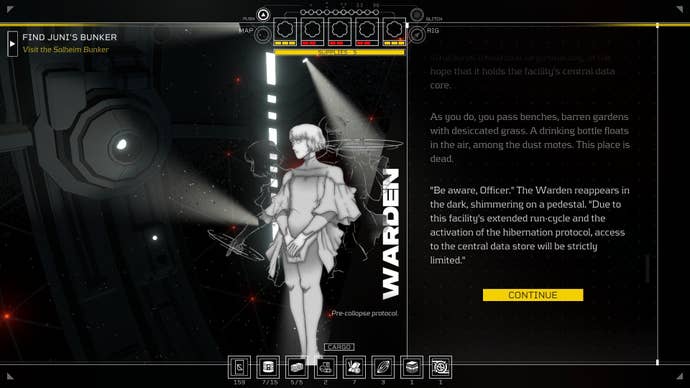
As before, it’s a solid way of giving the story some gamey bones.
But this heavier emphasis on the technicalities sometimes feel overbearing.
The more linear hubs especially can feel like there’s only one railroaded way to distribute dice.
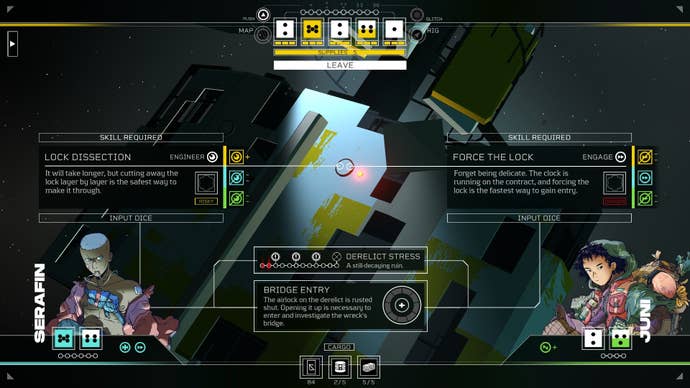
For me, these numerical systems werealways less interestingthanthe characters and stories that orbited them.
There’s still a lot to like in the people here.
Crucially, when these characters speak they feel alive.
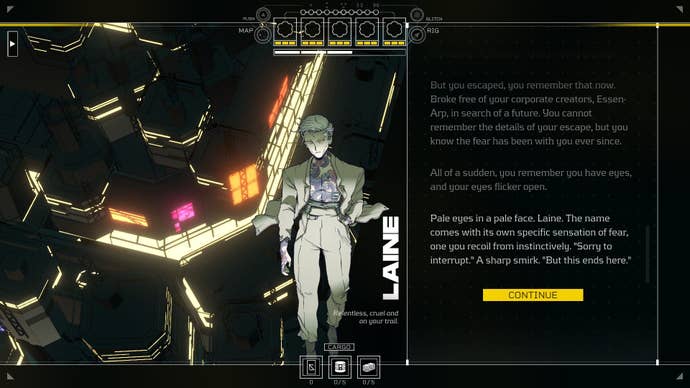
You will have to get out of dodge before he arrives.
There are other memorable folks.
There are a lot more examples of such characters.
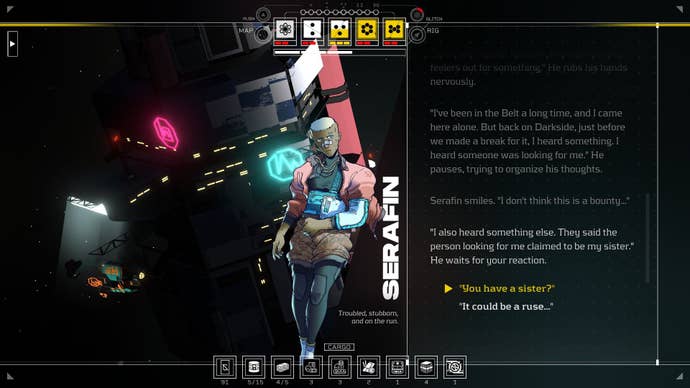
But what unites many is a sense of transience.
That said, they’re not all so compelling to me.
Many of your shipmates seem to suffer a dose of the “niceys”.
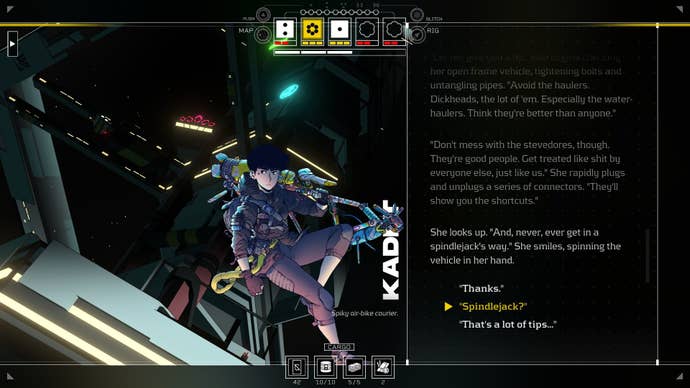
Conflict is resolved readily, and kindness prevails more often than conflict erupts.
For many others, a kinder-hearted crew may be a winner.
But I know I’m not alone inyearning for a scumbag or twoin my fictional ensemble.
Take your saviour Serafin, for example.
He’s a good-hearted and competent pilot, and your close buddy throughout the game.
I would like a friend like him in real life.
In-game, I wanted to hiss him out the airlock.
He is strong-willed, caring, thoughtful, and resolute.
I wanted to abandon him in an asteroid field after a couple of hours.
In fairness, some of the shuttlestops are fine adventures.
But I was anticipating a more open-ended tale right from the beginning.
It is geographically a broader game than the first, yet it feels somehow more confined.
Don’t let me scare you too much.
Scenes are still well-written, the expressive prose maintaining a good eye for body language and mannerisms.
At least, this is the case for much of the game.
Thematically, it’s loyal to its progenitor.
The firstCitizen Sleeperhauled its disdain for interstellar capitalism right to the centre of your story.
It’s finely made sci-fi, even if I still prefer the noodles on Erlin’s Eye.
Disclosure: Jump Over The Age’s developer Gareth Damian Martin has written for RPS
