On this page:
How does chemistry work in FIFA 23?
The most substantial change to chemistry in FIFA 23 is the removal of positional links.
Its worth noting thatif you place a player in the wrong position, they will not gain any chemistry.

FIFA 23 also makes the chemistry system much more positive.
Chemistry will only add to your players attributes.
Bear in mind that a player must be played in the correct position to earn chemistry in FIFA 23.

However, you’re able to also stack points from various criteria.
For example, look at the three ways to earn one chemistry point.
These chemistry points stack, so each of these players will have a total chemistry rating of three.
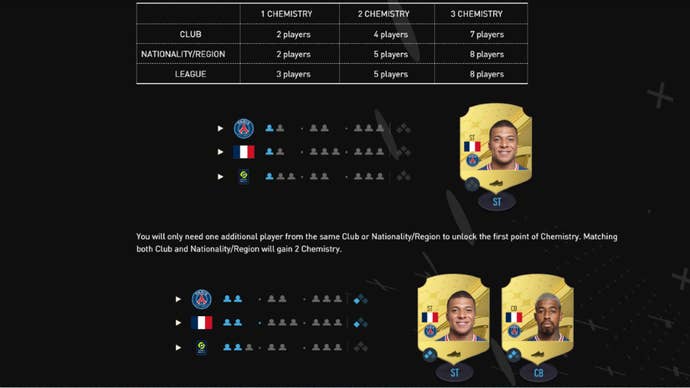
How do heroes and icons affect chemistry in FIFA 23?
They also have a larger impact on the thresholds mentioned above.
This makes heroes and icons incredibly valuable in Ultimate Team.

How do substitutions affect chemistry in FIFA 23?
Once you start a game in FIFA 23, your chemistry score is locked and will not change.
If your player is already Lengthy, consider using Hunter for its boost to Pace and Shooting.

Marksman takes the bottom spot due to its low spread of points across Shooting, Dribbling, and Physical.
Anchor comes next, as it offers upgrades to Pace, Defending, and Physical.
The Pace upgrade is less than that given by Shadow, but the Physical boost makes up for that.
Gladiator takes the bottom spot due to its Shooting boost, which doesn’t prove relevant for a defender.
These are three incredibly important stats for a goalkeeper, with Positioning and Diving proving particularly important.
However, it fails to improve Reflexes, which is perhaps the most important GK attribute.
This is why Basic takes the second spot, as it provides a minor upgrade to every GK stat.
These stats are rarely relevant for a goalkeeper, and would be much better suited elsewhere.
