Come and read the full Q&A below.
In the meantime, here’s our full chat with Gabe Newell.
Is the Steam Deck the handheld that Valve always wanted to build?
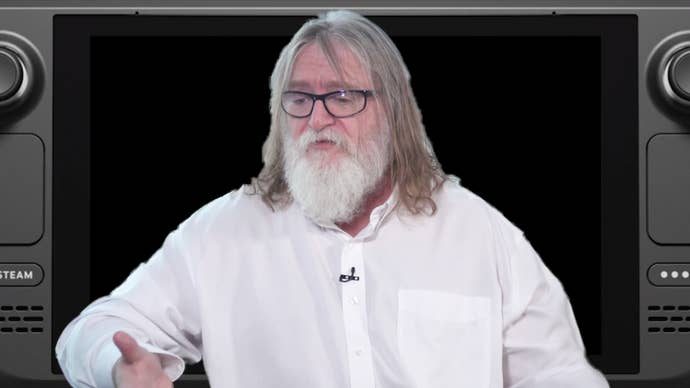
How happy are you with how it turned out?
I’m super happy.
How did you come to this price point?
Whereas for the handheld gaming unit, traditionally, that’s been a much more price sensitive category.
The critical thing wasn’t to expand, radically, the definition of what PC gaming was.
The critical thing was, in a price efficient way, to deliver that experience to a mobile audience.
So you’re correct in pointing out that they were targeted at different goals.
And that’s because of the segments that they’re going to be operating in.
It was, I think, in retrospect, probably not as critical to hit the price point.
I think we obsessed about it very hard.
I mean, not preferred, we’re definitely selling a lot of the entry level SKU.
So that’s sort of interesting.

That may shift because right now we’re very much at the early adopters, tidal wave of ordering.
And so maybe over time, we’ll see a change-up in the SKUs.
It’s just to go ahead and make those choices.
Youve previously said that the openness of the PC ecosystem is its superpower.
Do you think that’s a problem for gaming as a whole?
How are you making your game developers better developers?
I mean, it’s a lot of fun.
How do you make your QA processes better?
that are real determiners of success.
So I don’t see any evidence that people are turning towards more closed approaches.
And also I just don’t think the PC industry will tolerate it.
So that’s something that we expect will continue.
I see no evidence of that today.
That isn’t to say it wouldn’t occur, but fundamentally, customers are in the driving seat.
And we’re super happy with that, right?
Customers don’t like stuff like exclusives or restrictions.
It’s pretty expensive to go against that.
Do you think these technologies have any role to play in games at all?
You have to separate the underlying technology versus which actors are utilising that technology.
Similarly, at one point Steam was accepting cryptocurrencies for payments.
And it turned out that it just made customers super mad.
So if you think of how much I make, right?
It happens to be denominated in things like euros or dollars or whatever.
Volatility is a bad thing in a medium of exchange.
And that’s just out of control, right?
So far Valve has been one of the more active companies in Linux gaming, the Steam Deck included.
Do you think you’ve been successful in making Linux and open source gaming more viable compared to Windows?
There’s a huge amount of effort to get to do the kinds of things we wanted to do.
With that, we needed flexibility that was traditionally not available to people.
Or did it have to be open from the start?
I think the openness of the PC is something we love, right?
We wouldn’t want to lock anything.
I don’t really see the value of locking people into anything.
You just know that sooner or later that thats going to occur.
Thats the same reason we justreleased the CAD files for the Deck.
You don’t know where it’s going to come from, but sooner or later it will come.
And that’s part of the power of participating in this kind of open world.
So that sort of goes against my blockchain stuff.
Everything is completely distributed.
You don’t need centralisation in centralised ledgers at all!
Has the Steam Deck had a similar effect for hardware?
I think we’re super excited about the Steam Deck.
And we’re also excited about where we can go with it over the next couple of iterations.
Like a bunch of stuff is just baked, right?
So yeah, we’re pretty fired up.
Weve a lot of appetite for continuing to have a go at be innovative.
I think we’re going to be doing this for a while, right?
We think there are a lot of opportunities.
I mean, theres a bunch of obvious stuff.
All that stuff will just happen transparently to customers.
I’m playing Final Fantasy XIV!
One of my sons was playing a bunch of Final Fantasy and he wanted me to play.
And I’d like I have no idea what you’re talking about.
(Transcript edited for clarity.)
