“One foot in cabala and the other in the laboratory.”
Four games, four forgotten pasts, four new beginnings, one descent.
Beware: major spoilers for the entire Amnesia series below.
But thereisa master plan, perhaps, in that there must always be thesuspicionof a master plan.
“And that sort of grows some tentacles that go out to historical events and gather them in.
And then those get connected to the entirety of the story.”

They are unable to resist putting the pieces together.
And in that regard, they are prototypical Amnesia protagonists.
Later in the book, Belbo knocks over a pile of manuscripts.

Casubon discovers that many canonical authors he had taken for rationalists and scientific positivists also dabbled in the occult.
Amnesia takes direct inspiration from all this.
Amnesia’s protagonists are alike deformed by their roles as the scavengers and reconstructors of each game’s events.

The critical missing link here is, of course, the past of each protagonist.
Or alternatively, do wicked things in turn.
One advantage of blending record with invention, after all, is that it’s ‘world-building for free’.

The machinations of conspiracy-thinking also have a surprising design benefit in supplying a kind of campaign pacing rig.
“In A Machine for Pigs, you see hints of the big city.
And in Rebirth, you’re able to see the desert of Algeria.
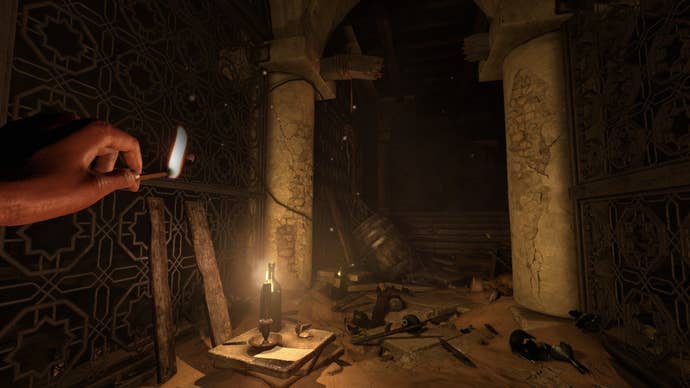
In some sense, they work as vistas and are not that different from how other games do things.
The historical realm offers no sanctuary here.
“And then you get shot by a sniper.

So it’s interesting - again, you could sort of peek through.”
Much like the Amnesia series as a whole, the dark world operates by means of cycles of forgetting.
It collapses everything into a single rite of repeated, futile remembering.

They occupy a flexible hinterland between empirical reality and make-believe.
To enter a mithraeum, you must descend.
Each is either built within, or designed to resemble a cave.
