Bless this mess
Picture the scene: you are at the beach.
It is a real-time strategy beach, where metaphors happen.
A lawless-looking child hands you a bucket.
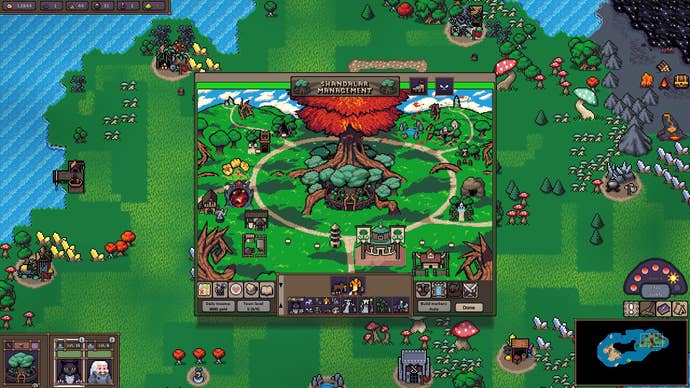
Isn’t this fascinating?
What the hell is going on?
And yet… it sorta does?
I don’t know.
How do I get off this beach?
All of which then auto-funnel to your hometown via little wagons.
This town is key to it all, since it’s the source of your soldiery.
Think of this as a pixel-poweredMount & Blademinus the esoteric role-playing and princess wooing.
Every day you’re given a limited travel distance.
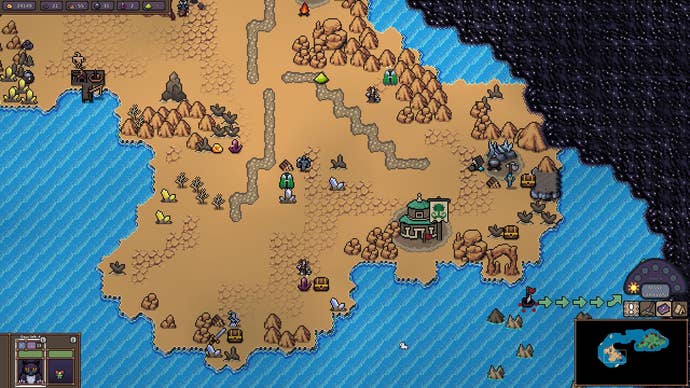
Go pick up that treasure chest, go assault that army.
When you’re out of marching juice the day is over, so click “end turn”.
After a week of these turndays, your stocks of soldiers in town greatly replenish.
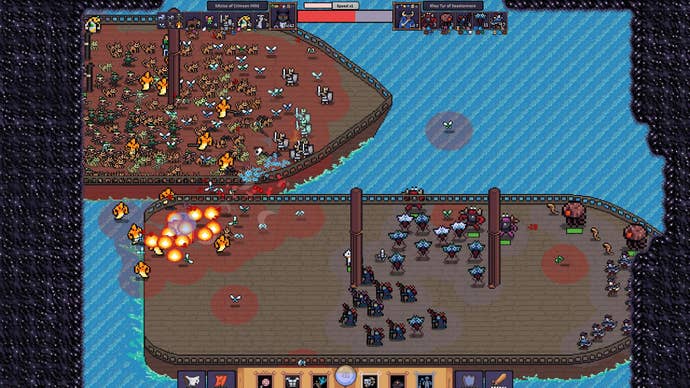
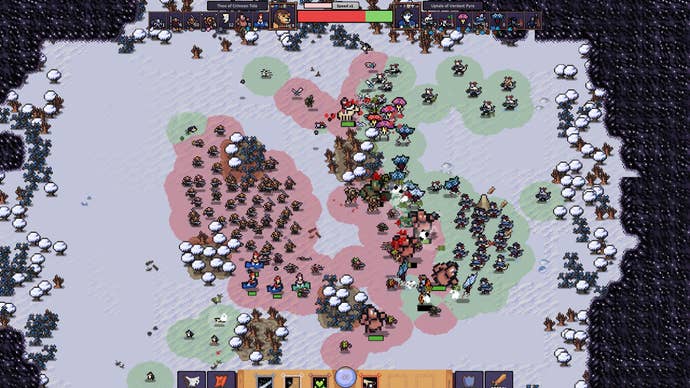
Battles are automated bust-ups that only give you a small role.
The idea is to have good numbers and well-trained troops going into the fight.
This isCrusader Kingsstyle Sun-Tzu-ing, notBattle Brothersstyle tactical improvising.
Painful, but delightful.
This is Hero’s Hour’s mushed-up medley at its best.
There’s a deceptively big library of units here.
I played one game as the nature-obsessed Wild faction.
Playing as these children of the forest has other advantages.
There are a lot of small flourishes of flavour like this.
A lot of neat unit design packed into a small space.
Which makes it a pity the UI is so rough.
There is tiny text in the unit explanations, everything looks basic, messages and stats are easily missed.
The tech trees are painful to decipher.
This is presumably to show some units are just physically bigger than others.
But the clash makes everything look like proportions are skewy.
It’s an untidy game.
It also doesn’t easily allow deep micromanagement of troop numbers.
“Okay, you, you and you, I guess, take a seat.”
Really, coach, you want the gigantic Treant to sit this one out?
As for the enemy’s intelligence, well, that depends.
However, competing factions are beasts of their own, and seek to expand as you do.
Their massive armies will show up on your doorstep while you’re away.
They will steal the boat you left unoccupied at the coast and use it to flank you.
Lucky that restarts are quick.
I wouldn’t call it a rougelike RTS, but it has a dusting of randomisation to each game.
The maps are always procedurally generated, for example, and spells learned by your hero are largely randomised.
And there’s a lot of helter-skelter stuff in there.
You get spells that turn your units into giants, or the enemy into frogs.
Spells that invoke the ghosts of fallen units to come fight for you.
The auto-scrapping battles lack tactical bite beyond the opening decisions about formation.
They’re very cool.
There are 11 factions in this war.
The RTS genre is almost always about triads.
In Hero’s Hour there is a surplus of weirdoes.
Zombie lads, fire idiots, gargoyle gang, dino jerks.
There are 177 different unit types.
It is about flavour and bedlam.
Fights in Hero’s Hour are less battles than they are riots.
I don’t know what to make of it.
It dubs itself an RTS but locks its map movement to turn-based limits.
For all the things I can say about Hero Hour’s design, it’s not by-the-numbers.
And I suppose that in itself is kind of remarkable.
